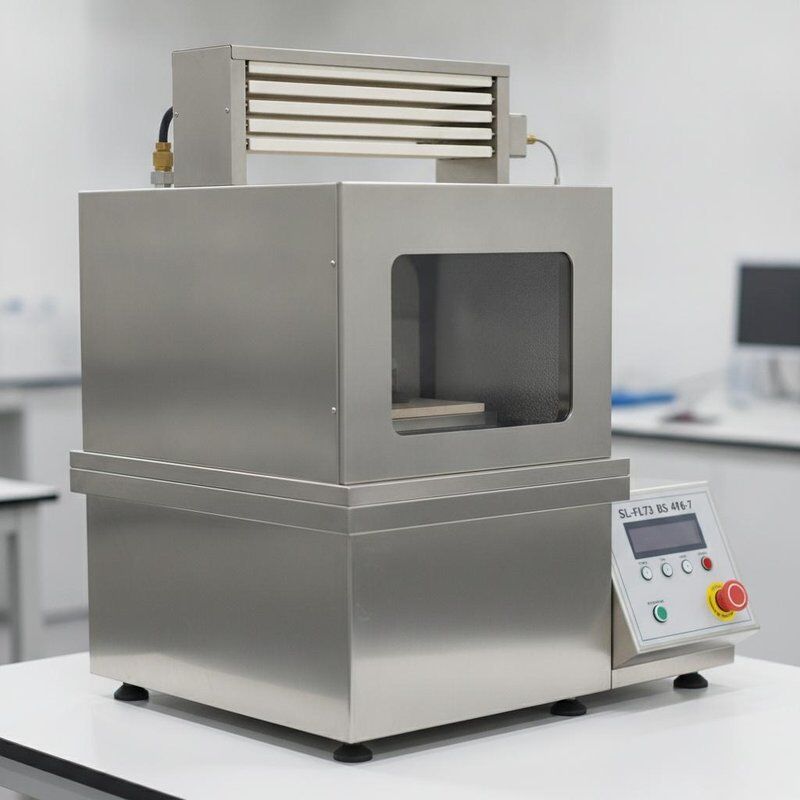
Unlock faster, more reliable fire safety certification for your wall and ceiling linings with the SL‑FL73 - the ultimate solution for BS 476‑7 surface spread flame testing.
Product Overview
The SL‑FL73 Surface Spread Flame Tester is a reaction‑to‑fire test system designed for wall and ceiling lining materials, measuring the lateral spread of flame along the surface of vertically oriented specimens under opposed flow conditions. It is used to evaluate building materials such as wallboards, ceiling panels, composite materials, and insulation linings for fire safety classification, providing essential data on flame propagation behaviour and surface spread rating.
Key Features
Radiant panel - 850 mm × 850 mm porous refractory burner block, operating at ~800 °C, with automatic gas shut‑off when de‑energised
Specimen holder - Water‑cooled steel frame with water‑cooled face plates overlapping the specimen by 20 ± 2 mm on top, bottom, and panel-adjacent edge
Pilot flame - Steel tube pilot burner with spark ignition, mounted beside the apparatus
Gas & air supply - Includes flow meters, pressure regulators, control valves, and safety devices
Control system - PLC with human‑machine interface for real‑time monitoring and test parameter control
Standards Compliance
BS 476‑7: Fire tests on building materials and structures -- Method of test to determine the classification of the surface spread of flame of products.
Applications
Wall and ceiling linings (wallboards, decorative panels, ceiling tiles)
Composite materials and assemblies used as exposed surfaces
Thermal insulation linings for walls and ceilings
Fire classification under BS 476‑7 (Class 1-4, and Class 0 for combined requirements)
Frequently Asked Questions
What standard does the SL‑FL73 comply with, and what does it measure?
It complies with BS 476‑7. It measures lateral flame spread along the vertical surface of a product under radiant heat and assigns a classification (Class 1 to 4) based on spread rate and distance.
Which materials can be tested, and what are the key specifications?
Wallboards, ceiling panels, decorative sheets, composites, and insulation linings. Key specs: 850×850 mm radiant panel (~800 °C), heat flux meter 0-50 kW/m² (ε=0.95), water‑cooled specimen holder, PLC control.
How accurate and repeatable are the results?
High accuracy is achieved through the porous refractory burner, stable gas/air control, and calibration with a reference flux sensor and perforated plate. The water‑cooled holder maintains consistent thermal conditions, and the hinged positioning ensures repeatable specimen placement.
Is the operation easy?
Yes. Spark ignition, spring‑loaded clamping, and PLC/HMI allow simple specimen mounting and automated test execution. Parameters are set on the interface, and real‑time data is displayed.
What are the installation requirements?
Install in a room at 10-35 °C with no draughts. Power: 230 V, 10 A. Gas: propane and compressed air. Test room volume: 400 m³. Maintenance includes regular cleaning of the radiant panel and routine calibration checks.
How does the classification system work?
Based on flame spread distance at 1.5 minutes and at the end of the test: Class 1 (lowest spread) to Class 4 (highest risk). Class 0 is a composite rating requiring Class 1 plus non‑combustibility.
To obtain the complete technical specifications, a quote, or to schedule a demonstration, please contact our sales team or authorized dealers. We will provide you with professional and prompt technical support and services.